
Last week the CBO released new demographic forecasts, updating their January estimates to account for changes in immigration policy. The population forecast for 2025 was cut from 0.7% to 0.2%, entirely accounted for by lower net immigration, which now contributes 0.1%. There were also smaller reductions to future years. It was well understood that there would be lower immigration forecasts given that border encounters have plunged, deportations have risen, and the budget reconciliation bill more than doubles ICE funding in coming years.
Even so, there are reasons to think the CBO didn’t go far enough in reducing immigration projections. In particular, the CBO assumes annual growth for “Other foreign nationals” is similar in 2025-26 (-250k) to 2019. This includes illegal immigrants and those on humanitarian parole programs or Temporary Protected Status (TPS), all of whom are targets of recent immigration policy changes.
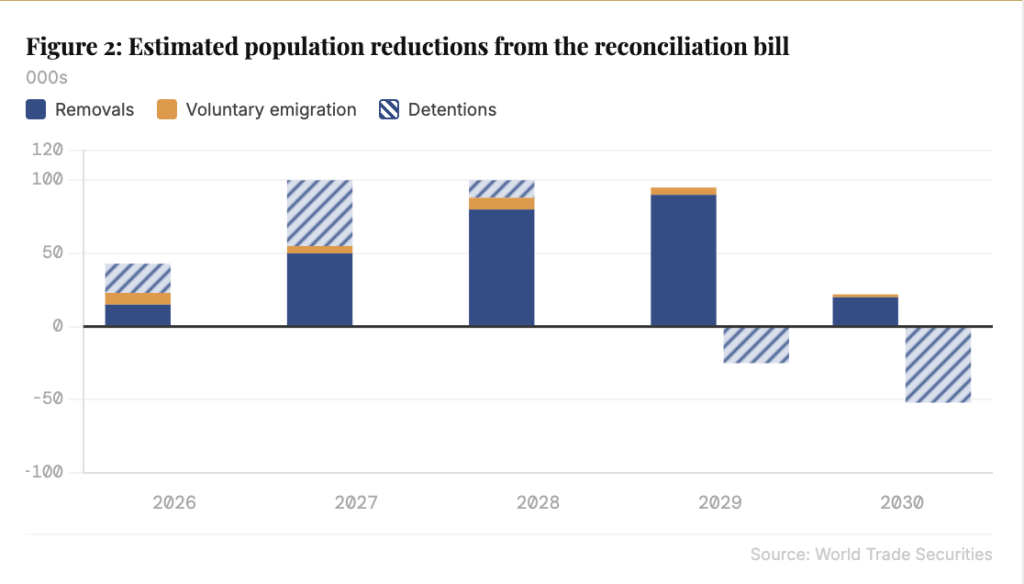
For the budget reconciliation bill, CBO estimates that the law will yield essentially no removals from the country before 2027 (Figure 2). Removals will then accelerate to a peak of close to 100k in 2028. Removals from the interior of the country were ~50k in FY24, so this would be a sizable increase in percentage terms, but total removals could still end up being lower than their peak in the Obama administration (Figure 3).
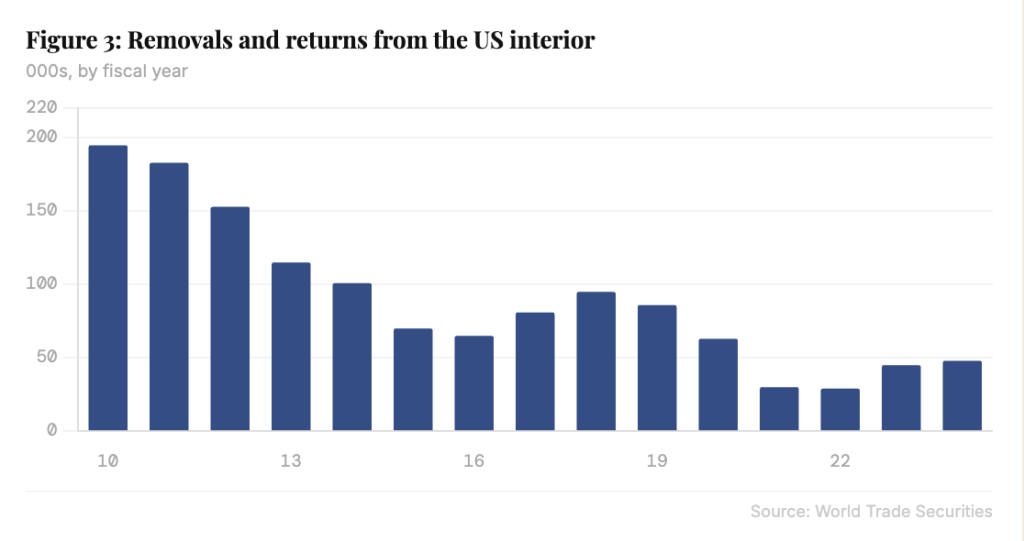
CBO also estimates that through mid-June there were 70k removals from the interior of the country, which aligns with DHS data, but then assumes the 1H25 rate holds for the rest of the year, yielding 140k total removals, excluding any effects from the budget bill. But deportations have been rising over the course of the year. If they were to hold indefinitely at August levels, 2025 interior removals would be closer to 225k, and 2025 removals at 300k.
Finally, as we discussed here, there could be over 1.5 million people losing TPS or humanitarian parole by early 2026 (there may be some overlap between these groups, as Haitians and Venezuelans had been eligible for TPS). The CBO esti- mates that half of TPS holders have obtained another status or have a pending asylum application that protects them from removal. That should still leave a sizable number of people subject to deportation, most of whom have likely been excluded from the higher realized deportation figures year-to- date since status has only recently started to change. Of people who have lost status, CBO estimates just 4k per year will leave voluntarily over 2025-27, but the analysis doesn’t assume the remainder will explicitly fuel higher future deportations.